Old Bailey
Great ExpectationsThe Old Bailey is a London criminal court whose episodes in Great Expectations expose the consequences of legal judgment for people marked by poverty, criminal status, and social power. Its contrasting cases show Jaggers using evidence and argument to secure Molly’s acquittal, while Magwitch’s return to England brings him before the law as a condemned transportee. The court’s procedures shape not only punishment, but also what can be proved and what a person is permitted to do afterward.
The Court and Jaggers’s Defense
Wemmick recounts that Molly was tried at the Old Bailey for murder and acquitted. The case concerned the death of a woman found near Hounslow Heath; circumstantial evidence pointed toward Molly, but Jaggers challenged the interpretation of the marks on her hands and the assumptions used to establish her guilt.
Jaggers’s defense offered an alternative account of those marks, pointing to evidence that Molly had passed through brambles. He also turned the prosecution’s claim about her jealousy and the possible destruction of her child back on the prosecution: if that hypothesis explained the marks, it did not prove the murder for which she was being tried. The jury accepted his argument. Wemmick says the case, which Jaggers worked through the police proceedings and at trial, won wide admiration and helped establish his reputation.
Magwitch and the Law of Return
The Old Bailey’s other crucial connection is Magwitch’s prosecution after he comes back to England, despite having been exiled for life. Jaggers had warned him that returning would be a felony carrying the extreme penalty of the law. When Magwitch is captured while trying to escape, the legal consequences of that return become decisive.
At the Police Court, Magwitch cannot immediately be committed for trial because officials need an officer from the prison ship to identify him. The absence of that witness delays the process, but does not erase the threat: Jaggers tells Pip that once the witness is present, the case will be over quickly and the conviction unavoidable. The court’s procedures therefore turn identity and proof into immediate practical obstacles, even when no one doubts who the prisoner is.
The Death Sentence as Public Ceremony
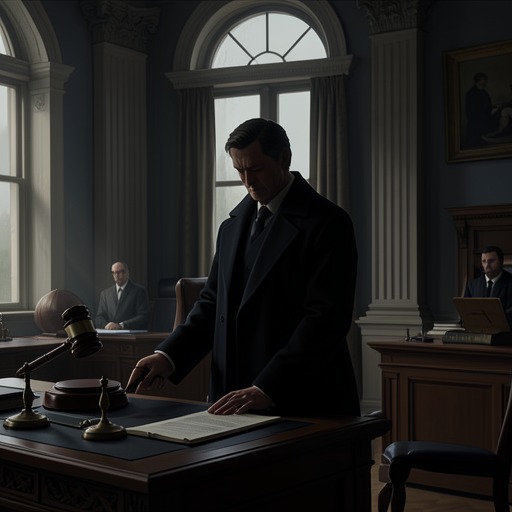
At the Old Bailey, Magwitch is sentenced alongside thirty-one other prisoners. The proceeding is presented as a public spectacle, with the condemned gathered before the judge and a large audience looking on. Magwitch, too weak to remain standing, is seated as the sentence is delivered.
The judge’s account traces his history of repeated offenses, imprisonment, exile, escape, and eventual return to England. It acknowledges that he had lived peaceably and honestly far from his former surroundings, but treats his return and the death of his denouncer as grounds for the prescribed punishment. Magwitch accepts the sentence, saying that he has already received his death sentence from God and bows to the judge’s. The scene makes the court the place where the law’s power becomes final and publicly visible.
Legal Power and Narrative Contrast
The two cases reveal different uses of legal procedure. In Molly’s trial, Jaggers makes the jury confront uncertainty in the evidence and wins an acquittal. In Magwitch’s case, the law treats his return from lifelong exile as a capital offense, and the missing identification witness appears to be only a temporary delay before conviction. Together, the episodes show how argument, evidence, and legal status determine the outcomes available to defendants.
The Old Bailey also connects professional advocacy to personal consequence. Jaggers’s skill once secured Molly’s freedom; later, his knowledge of the law helps Pip understand why Magwitch cannot safely remain in England and why his conviction threatens the inheritance Magwitch intended for him. The court thus stands at the intersection of legal procedure, punishment, and the novel’s central questions about guilt, social judgment, and the possibility of a changed life.